Service 05
Moving wood is half of the pallet business
Pallets are cheap and bulky, which means freight is usually the biggest number on the invoice. Send us the origin, destination and count, and we pass it to partner suppliers and carriers in our network — ideally ones who can bring a delivery back loaded instead of empty.
Short answer
Flatbed, dry van, lift-gate and walking-floor equipment are all available through partners in our network for requests from Denver and Colorado; availability depends on partner suppliers.
Backhaul pricing is worth asking for whenever a delivery can collect on the return leg.
Coverage
Distance bands from the Denver metro
Lead time and freight basis both tend to follow distance. These are typical patterns; actual terms are set by the supplier or carrier who quotes.
| Band | Area | Typical freight basis |
|---|---|---|
| 0 – 25 mi | Denver metro, Aurora, Commerce City | Flat metro rate |
| 25 – 75 mi | Boulder, Longmont, Castle Rock, Greeley | Flat + mileage |
| 75 – 150 mi | Fort Collins, Colorado Springs, Pueblo | Mileage |
| 150 mi + | Grand Junction, Durango and the rest of Colorado | Mileage + fuel |
Distance bands around the Denver metro. Availability further out depends on partner suppliers and carriers.
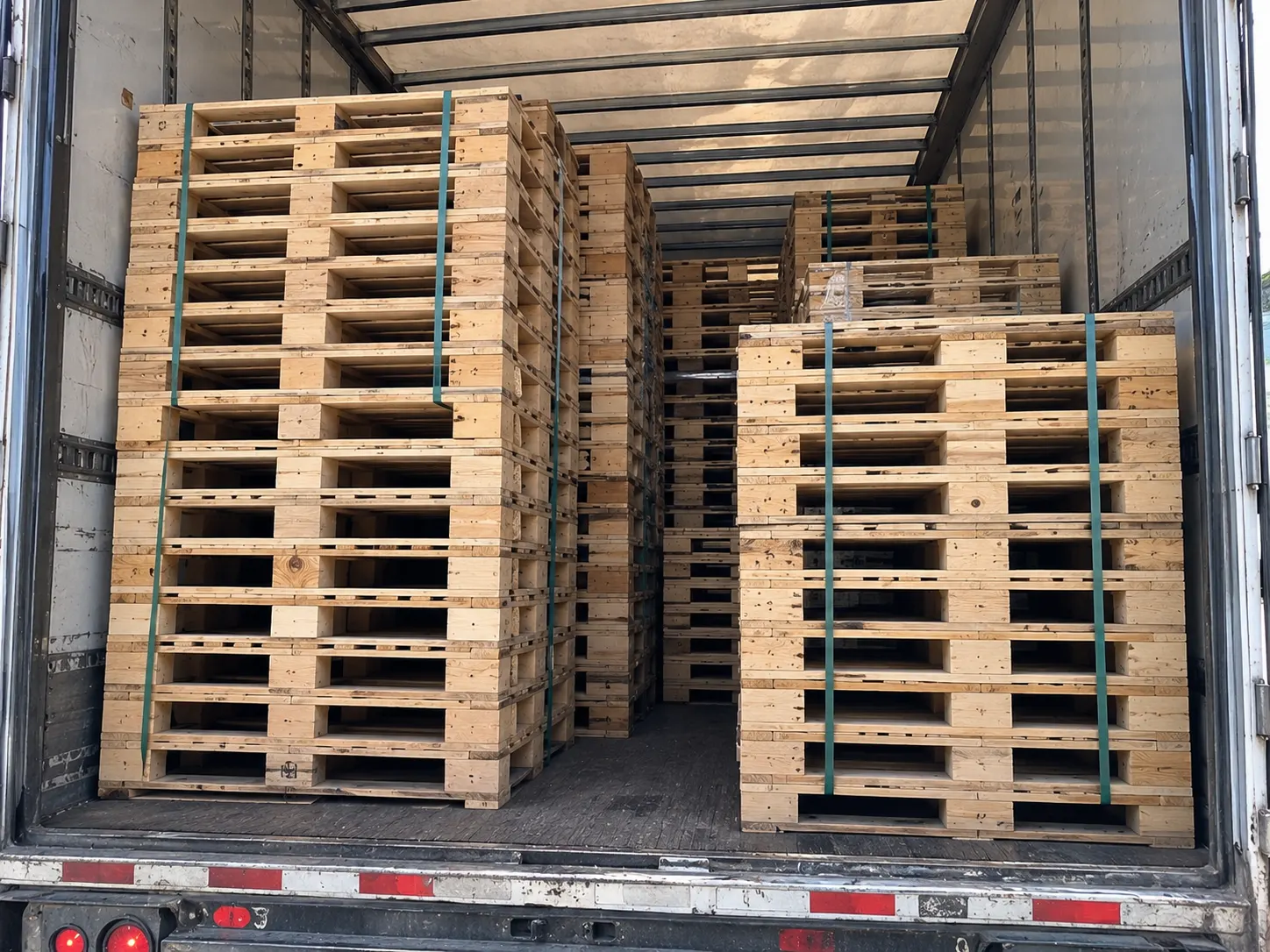
What a load looks like
Banded, labelled, photographed, then dispatched
Two habits separate careful suppliers from the rest: a grade check of the pulled stock against the order, and a photograph of the loaded trailer before it leaves.
| Equipment | 48×40 capacity | Best for |
|---|---|---|
| 26' box, lift gate | 120 – 160 | Sites with no dock |
| 48' flatbed | 260 – 300 | Yard to yard |
| 53' van, single stack | 500 – 560 | Dock to dock |
| 53' van, double stack | 880 – 1,040 | Low-profile stacks, 100 in height |
| Hot shot | 80 – 140 | Urgent shortfalls |
Equipment
What can go under your freight
| Equipment | Capacity | Best for | Notes |
|---|---|---|---|
| 48' flatbed | 260 – 300 pallets | Yard-to-yard, banded stacks | Straps and tarps |
| 53' dry van | 500 – 1,040 pallets | Dock-to-dock, weather-sensitive | Double stack where height allows |
| 26' box truck, lift gate | 120 – 160 pallets | Sites with no dock | Ground-level delivery |
| Walking floor trailer | Full trailer of fibre | Mulch and ground wood | Self-unloading |
| Hot shot | 80 – 140 pallets | Urgent shortfalls | Premium rate |
| Rail drayage | Container loads | Long-haul reclaimed lumber | Contracted |
| Dedicated route truck | By agreement | Standing weekly collections | Recurring pickup customers |
Key takeaways
- Backhaul is the single biggest lever on your freight cost — a trailer that returns loaded is a trailer you only pay for once.
- Double stacking cuts freight per unit sharply, but needs a 100-inch internal trailer height and low-profile stacks.
- Lift-gate delivery costs more but far less than a refused delivery and a second dispatch.
- Mulch and ground fibre need a walking floor; a flatbed cannot unload it and a van cannot carry it loose.
Questions
Freight questions
Can I get freight that is not pallets?
Within reason. Lumber, crates, bins, machinery on skids and general palletised freight can often go with a pallet supplier, particularly on a backhaul. For general freight, a dedicated freight broker is usually the better fit.
Will the carrier be insured for our dock?
Commercial carriers carry auto and general liability cover. If you need a certificate naming your entity as additional insured, ask the supplier or carrier for it before the first delivery.
Can delivery go to a job site rather than a warehouse?
Usually — construction sites, event builds, farms and greenhouses are common. Describe the ground conditions in your request. A 53-foot trailer on soft spring mud is an expensive afternoon for everyone.
Is there a fuel surcharge?
It depends on the carrier and distance. Ask for fuel to be quoted into the rate rather than added later, so the number you approve is the number you are invoiced.
Load planning
What fits, what it weighs, and what is legal
Three constraints bind a pallet load: trailer cube, axle weight and dock access. Empty pallets hit cube first; loaded pallets hit axle weight long before the trailer is full.
| Count | Weight | Equipment | Notes |
|---|---|---|---|
| 100 | 3,800 lb | Box truck | Cube limited |
| 150 | 5,700 lb | Box truck | Cube limited |
| 300 | 11,400 lb | Flatbed | Tarp in weather |
| 500 | 19,000 lb | 53' van, single | Standard load |
| 700 | 26,600 lb | 53' van, part double | Needs height |
| 1,000 | 38,000 lb | 53' van, double | 100 in internal |
| 1,040 | 39,520 lb | 53' van, max | Practical maximum |
| Limit | Value | Usually binds when |
|---|---|---|
| Gross vehicle weight | 80,000 lb | Dense freight |
| Single axle | 20,000 lb | Nose-heavy loads |
| Tandem axle group | 34,000 lb | Most commonly |
| Legal payload | Gross limit minus the truck's own weight | Ask the carrier |
| Overweight or oversize loads | Need a permit | Heavy machinery |
Loaded weights
What a full pallet of your product weighs
A rough guide to whether a load runs out of weight or space first. Weigh a typical unit load of your own product to be sure.
| Commodity | Unit load | Binding constraint |
|---|---|---|
| Canned beverage | Heavy | Axle weight |
| Bottled beverage, glass | Heavy | Axle weight |
| Paper, sheet stock | Very heavy | Axle weight |
| Paper, roll stock | Heavy | Axle weight |
| Bagged cement, aggregate | Heavy | Axle weight |
| Brick and block | Very heavy | Axle weight |
| Canned food | Heavy | Axle weight |
| Dry goods, cereal | Light | Trailer cube |
| Fresh produce | Medium | Trailer cube |
| Nursery stock | Light to medium | Trailer cube |
| Appliances | Light, bulky | Trailer cube |
| Apparel, soft goods | Light | Trailer cube |
Freight
Five freight mistakes, in order of cost
- 01
Sending the trailer home empty
A truck costs almost the same loaded or empty — driver time, equipment, insurance and depreciation do not vary at all, and fuel varies only modestly on light freight. A one-job round trip pays for the whole trip.
Instead: Mention a delivery and a collection in the same request. Filling both legs can cut freight per pallet substantially.
- 02
Insisting on a fixed delivery time
A delivery that must arrive Tuesday at 09:00 is a dedicated trip. A delivery that can arrive Tuesday or Wednesday gets slotted onto a run that was happening anyway.
Instead: Accept a two-day window where you can. On a longer delivery it can make a noticeable difference to the quote.
- 03
Not checking whether your dock allows double stacking
Double stacking cuts freight per unit sharply and needs about 100 inches of internal trailer height plus stacks banded to the right height. Many sites in newer buildings qualify without knowing it.
Instead: Measure your door height and ask. It takes one email and can cut a recurring cost permanently.
- 04
Ordering site by site across a multi-site operation
Four sites each ordering 60 pallets is four trips. The same 240 units dropped across four stops on one route is one trip.
Instead: Consolidate onto a route. Multi-site operations often save more on freight than on product.
- 05
Discovering access problems on the day
A 53-foot trailer needs about 60 feet of approach. Soft spring ground, low canopies, tight gates and shared loading areas all end in a failed delivery and a billable second attempt.
Instead: Two sentences about your site in the first request.
Common equipment at a glance
- 48' flatbed
- 260 – 300 pallets
- 53' dry van
- 500 – 1,040 pallets
- 26' box, lift gate
- 120 – 160 pallets
- Walking floor
- Full trailer of fibre
- Hot shot
- 80 – 140 pallets
- Rail drayage
- Container loads
- Dedicated route truck
- By agreement
Site details that change the quote
All of them are better mentioned than discovered.
- Dock height, or no dock at all
- Longest trailer that can physically reach you
- Approach length and turning radius
- Ground conditions, especially in spring
- Canopy and door heights
- Hours you can receive
- Whether a forklift is available
Origin, destination, count
That is enough for a freight number. Add the dock details and a partner supplier or carrier in our network will follow up with a quote.