Service 03
Recycling, in the original sense of the word
Much 'wood recycling' just means grinding. At a good pallet recycler grinding is the last resort, not the service: a pallet is first examined for reuse, then for repair, then for part recovery — and only what fails all of those is ground. We match you with partner recyclers in our network who work that way.
Short answer
Most inbound pallets at a repair-first recycler leave as working pallets. Wood that cannot be repaired is usually ground into landscape mulch, animal bedding fibre or biomass fuel.
The hierarchy, applied in order
Four tests before anything is ground
This order is the entire difference between a recycler and a grinder, and it is why repair-first recyclers can often pay for material that grind-only operators charge to accept.
01
Can it ship as-is?
Re-grade and re-stamp. The fastest and cheapest outcome.
02
Can it be repaired?
Companion boards, plugs, re-decking, stringer repair.
03
Can parts be recovered?
Sound boards, stringers and blocks pulled for repair stock and reclaimed lumber.
04
Grind it
Hammermill, screen, de-steel. Becomes mulch, bedding fibre or boiler fuel.
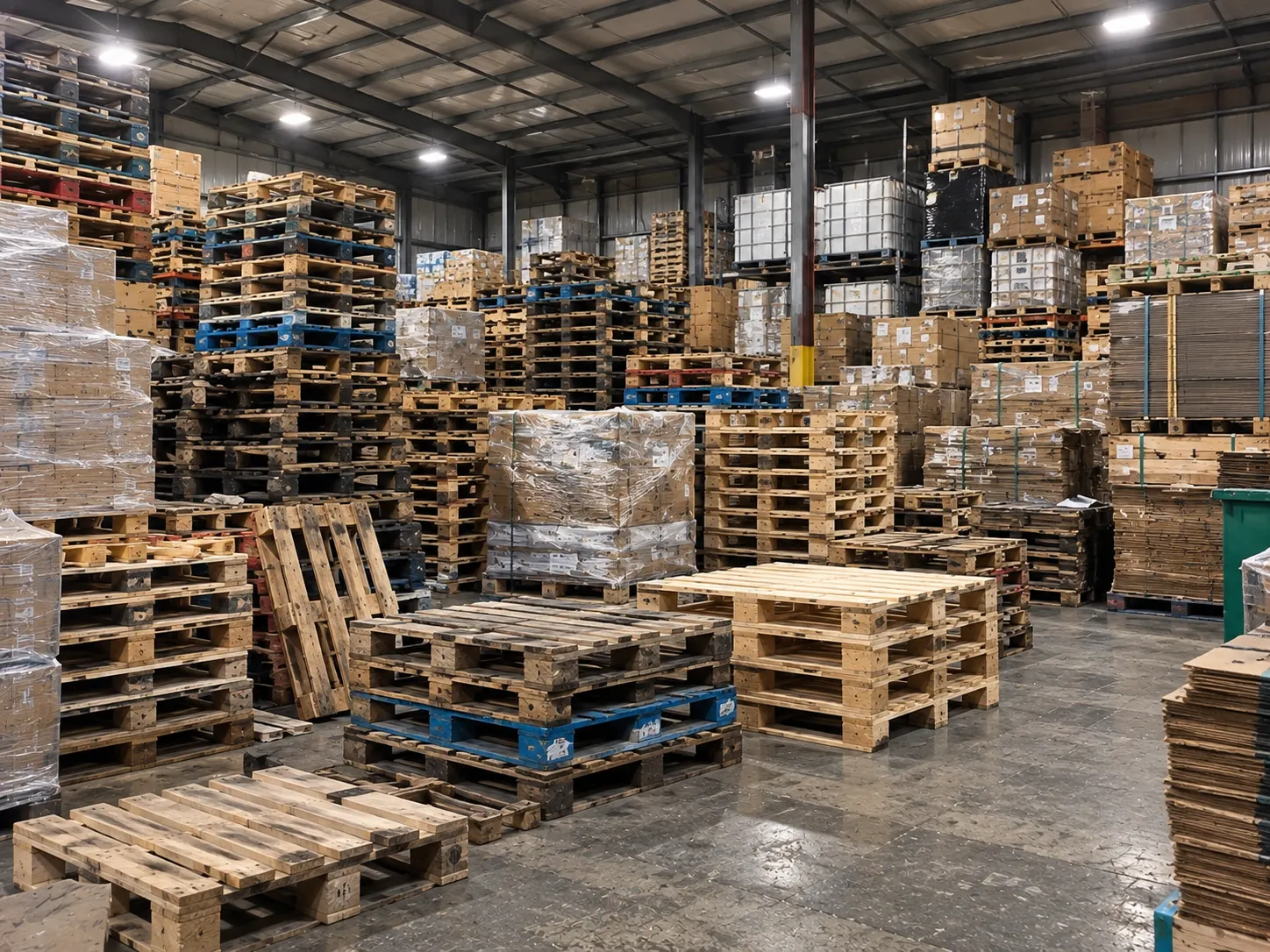
Before the grinder
Four tests, and grinding is the fourth
Many operations describing themselves as wood recyclers are really grinders. At a repair-first recycler the grinder is near the end of the process, and if it is doing much work the steps ahead of it have failed.
| Test | Question | Outcome |
|---|---|---|
| 1 | Can it ship as-is? | Reuse |
| 2 | Can it be repaired? | Reuse |
| 3 | Can parts be recovered? | Reuse as parts or lumber |
| 4 | Grind it | Recycling or energy recovery |
What recyclers accept
Wood and more
| Material | Usually accepted | Typical terms |
|---|---|---|
| Whole pallets, any condition | Yes | Often paid, by grade |
| Broken pallets and cores | Yes | Often paid as repair cores |
| Loose pallet lumber | Yes | Often paid by the ton |
| Wood crates, boxes, bins | Yes | Often paid, by size |
| Clean dimensional offcuts | Yes | Free to paid by the ton |
| Plywood and OSB | Often | Free drop or small fee |
| Plastic pallets and bins | Some recyclers | Rebate on single-resin loads |
| Painted or coated wood | Case by case | Tip fee may apply |
| Treated lumber (CCA / ACQ) | No | Licensed handler |
| Chemically contaminated wood | No | Licensed handler |
Key takeaways
- Recycling usable pallets often pays you rather than costing you — that is the point of repair before grinding.
- Treated lumber (green or brown pressure-treated) cannot enter a mulch stream.
- Steel recovery matters: magnetic separation pulls nails and banding out of ground wood so it can be scrapped.
- If you need diversion certificates, ask for them in your request so you are matched with a recycler who issues them.
Questions
Recycling questions
Is pallet recycling free?
Often better than free. Usable pallets usually earn a buy-back rate, and loose wood may earn a per-ton rate. Contaminated or coated material can carry a handling fee — ask the recycler before collection rather than finding out on the invoice.
Can I drop pallets off myself?
Many recyclers accept drop-offs. Mention it in your request and the partner recycler will tell you where, when and how they pay — by net weight or by unit count.
What about household quantities?
Some recyclers will take a pickup bed of pallets without charge, though small quantities are rarely paid for. Ask in your request.
What happens to the nails?
Magnetic separation after grinding pulls nails, staples and banding out of the fibre stream, and that steel goes to scrap. It is also what makes pallet mulch safe to spread.
Reading a diversion report
Where an inbound ton of pallet wood typically goes
A diversion claim is only meaningful if every pound can be accounted for. A credible report from a recycler splits output into streams like these.
| Output stream | Typical destination | Treatment category |
|---|---|---|
| Pallets shipped as-is | Pallet users | Reuse |
| Pallets shipped after repair | Pallet users | Reuse |
| Boards and stringers recovered | Repair stock | Reuse |
| Reclaimed lumber | Fabricators and makers | Reuse |
| Landscape mulch | Landscape contractors | Recycling |
| Animal bedding fibre | Stables and farms | Recycling |
| Boiler-grade hog fuel | Biomass boilers | Energy recovery |
| Scrap steel | Scrap processors | Recycling |
| Residue | Landfill | Disposal |
What it is worth to you
Recycling that pays rather than costs
The repair-first hierarchy is not an environmental gesture. It is the reason a repair-first recycler can often pay for material that a grinding operation has to charge to accept.
| What you have | A grind-only operator | A repair-first recycler | Why the difference |
|---|---|---|---|
| Grade A 48×40 | Scrap value at most | Usually paid, top of the range | It resells as a pallet |
| Grade B 48×40 | Scrap value at most | Usually paid | Repairs to Grade B and resells |
| Grade #2 48×40 | Scrap value | Often paid | Repairs or yields parts |
| Broken cores | Scrap value | Often paid as cores | Several good boards each |
| Block pallets | Scrap value | Usually paid well | Scarce and in demand |
| Euro / EPAL stamped | Scrap value | Usually paid well | Scarce in this market |
| Wood crates and bins | Scrap value | Often paid, by size | Reusable containment |
| Loose lumber | By the ton, low | By the ton, higher | Sorted into repair stock |
| Plywood and OSB | Tip fee | Free drop or small fee | Goes to fibre |
| Single-resin plastic | Tip fee | Sometimes a rebate | Regrind market |
Setting it up
From first request to a standing stream
The paperwork is usually short, and most of the setup is agreeing how counts and grades are recorded.
- 01
Send a photo and a rough count
That is the entire request. A phone photo tells a recycler more about grade mix and contamination than any description, and a count to the nearest fifty is enough to send the right vehicle.
- 02
We match your request
We pass it to partner recyclers in our network that collect in your area.
- 03
A recycler quotes a band and a window
A per-unit range by expected grade, plus collection terms, from the partner recycler.
- 04
A short collection agreement
Usually first time only. It should cover ownership of the material, contamination, and how counts are agreed.
- 05
Collection, counted at your dock
Agree the count with the driver on site and both sign. That signed sheet should govern any later question about quantity.
- 06
Sorted and graded
Ask for the sort sheet showing the actual grade breakdown rather than an averaged assumption.
- 07
Set a trigger count
Rather than a calendar date. 'Call when we hit 200' means the stack never becomes urgent and never becomes a fire-code problem.
What a good diversion report includes
Worth asking for if your waste or ESG team needs documentation.
- Tonnage received, from scale tickets
- Tonnage diverted, and the diversion percentage
- Split by stream, with each destination named
- Treatment category per stream — reuse, recycling, energy recovery
- Site-level figures plus a consolidated roll-up
- Underlying scale tickets, available to your auditor
Questions to ask before trusting a diversion claim
- Is there a mass balance behind the percentage?
- Are tonnages from scale tickets or estimates?
- Is the data third-party verified, or internally audited?
- Is energy recovery reported separately from recycling?
- Is biogenic carbon or a combustion credit being counted?
- Can your auditor see the records?
Stop paying to bury wood
Tell us your weekly volume and a partner recycler in our network will quote what the same material is worth as a recycling stream.