Built fresh, sold honestly
New pallets, for the four reasons that justify them
We lean towards reuse, so we will talk you out of new lumber whenever a reclaimed deck will do the job. There are four situations where it will not — and in those, a properly engineered new pallet from a partner supplier is cheaper than the failure it prevents.
Short answer
Buy new when: the load exceeds reclaimed ratings, the environment demands uniform clean lumber, the receiving customer specifies new, or the footprint does not exist used.
New builds are priced by quote from partner suppliers — species, construction, volume and delivery distance set the number, and the supplier confirms the lead time.
The four cases
When fresh lumber earns its premium
- 01
The load is beyond reclaimed ratings
At the top end of the dynamic ratings for a 48×40 footprint, reclaimed stringers stop being predictable. New lumber with specified board thickness and fastener count gives you a number you can put in a safety case.
- 02
The environment needs uniform, clean wood
Cosmetics, nutraceuticals and some cannabis operations require lumber with no prior service history, no staining and no unknown residues. That is a new-build requirement, not a grading one.
- 03
Your customer wrote "new" into the PO
Some retail and automotive programmes simply specify it. Arguing costs more than complying, so partner suppliers build and stamp to the spec.
- 04
The footprint does not exist in reclaimed stock
A 62×38 platform for a packaging machine is never going to turn up in a trailer of returns. A partner supplier's saw line builds it to order.
New builds typically leave the line banded, often with the build date and load rating stencilled on the lead board.
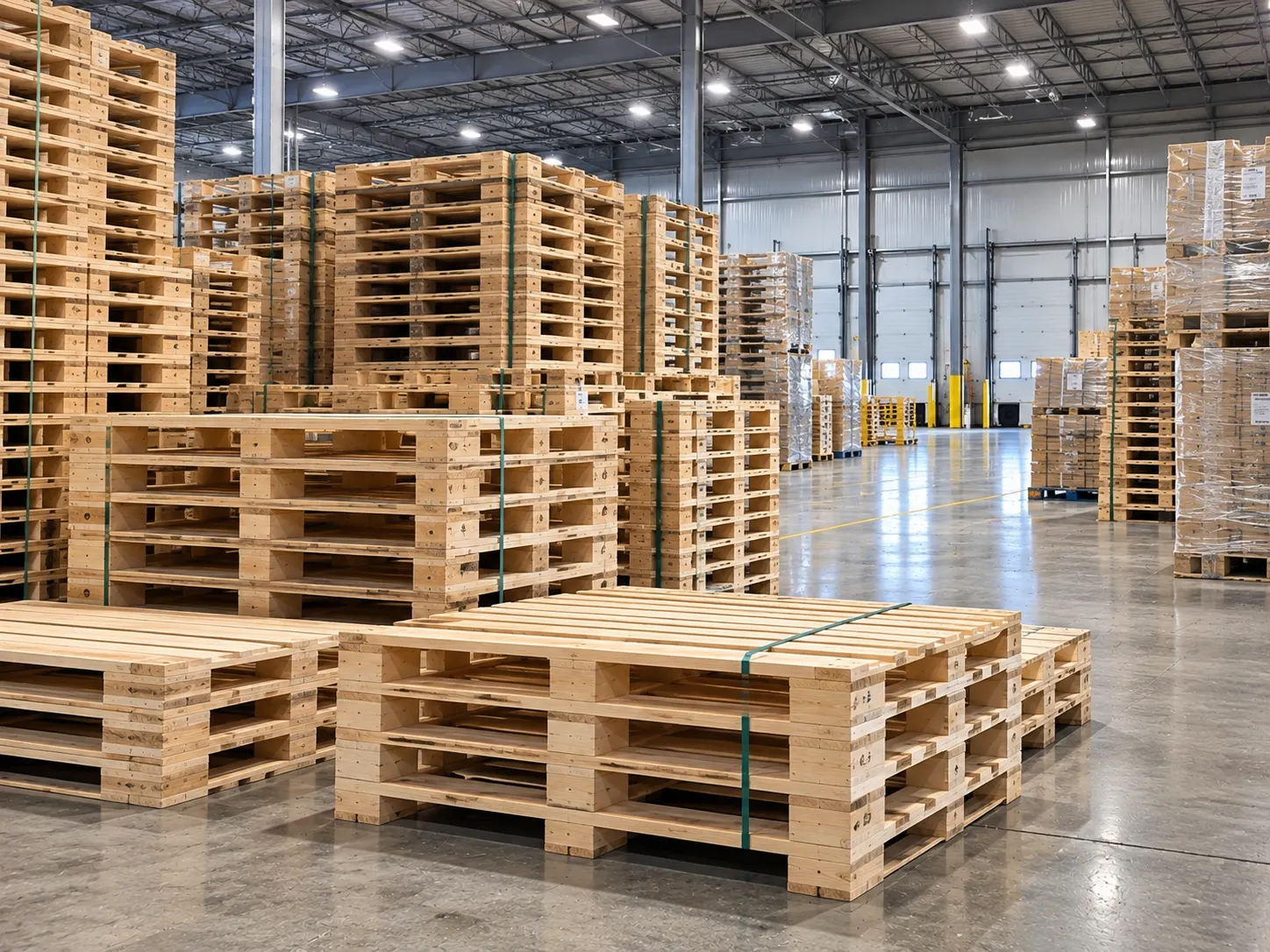
Built on the saw line
New stock, stencilled with its build date and load rating
New builds typically leave the line banded, often with the build date and declared rating stencilled on the lead board. Lumber species, board thickness, fastener type and count should all be declared on the quote — if a supplier will not declare them, there is a reason.
Specifications
What a standard new build actually is
Lumber species, thickness, fastener type and board count should all be declared on the quote. These are the typical specifications partner suppliers build to.
| Element | Specification |
|---|---|
| Lumber | SPF / mixed hardwood, kiln-dried |
| Top boards | 7 × 0.625" (2 lead boards at 5.5") |
| Bottom boards | 5 × 0.5", chamfered leading edges |
| Stringers | 3 × 1.375" × 3.5" × 48", notched |
| Fasteners | Helically threaded hardened nails, 68 per unit |
| Empty weight | 41 – 46 lb |
| Dynamic load | 5,200 lb |
| Racked load | 3,100 lb |
| Element | Specification |
|---|---|
| Lumber | Kiln-dried hardwood deck, SPF blocks |
| Top boards | 7 × 0.75", flush edges |
| Bottom boards | 3 full-width stringer boards |
| Blocks | 9 × 3.75" × 3.75" × 3.75" |
| Fasteners | Drive screws, 96 per unit |
| Empty weight | 56 – 62 lb |
| Dynamic load | 6,400 lb |
| Racked load | 3,600 lb |
Key takeaways
- Moisture content matters: wet lumber shrinks, loosens fasteners and grows mould in a sealed trailer.
- Helical nails and drive screws hold far better under withdrawal than smooth shank.
- Board thickness, not board count, usually governs deflection under a concentrated load.
- A well-built new pallet that comes back to you can make many trips before it needs major repair.
Fair comparison
New versus recycled, side by side
| Measure | New build | Recycled Grade A | Recycled Grade B |
|---|---|---|---|
| Relative price | Highest | Lower | Lowest of the three |
| Dynamic load | 5,200 lb | 4,200 lb | 3,600 lb |
| Racked load | 3,100 lb | 2,600 lb | 2,000 lb |
| Lumber | Uniform, declared | Sound, mixed history | Sound, visible repairs |
| Availability | Built to order | Usually in stock | Usually in stock |
Unit price is only part of the story: how many trips a pallet completes, and whether it comes back, matters more. Reuse also avoids building a new pallet at all, which is why a reclaimed unit usually wins when it will carry the load. More on comparing options in the pallet procurement guide.
Questions
Common new-build questions
Can I get documented or certified lumber?
Partner suppliers source lumber from a range of mills. If your project needs chain-of-custody paperwork, say so in your request and we will match you with a supplier that can provide it. Ask at quote stage — retrofitting documentation after a build is painful.
Can new pallets be stencilled or branded?
Many partner suppliers offer it — company name, PO number, load rating, return instructions or a simple colour band on the stringer ends. Colour banding is the single cheapest way to get pallets back, because drivers can see at a glance whose they are.
Do new pallets need heat treatment?
Only if they cross a border. New does not mean compliant — ISPM-15 is a treatment standard, not a condition standard. See heat-treated pallets.
Can they be sold back later?
Usually. Sound new builds are among the easiest pallets to sell on, and partner buyers in our network can quote for them when you have surplus. What they offer depends on grade, count and location. See selling surplus pallets.
Lumber
What new pallets are built from, and why species matters
A pallet is a lumber product before it is a handling product. Species sets stiffness, fastener holding and weight — and the cheapest board is rarely the cheapest pallet.
| Species group | Density | Stiffness | Fastener holding | Weight penalty | Used for |
|---|---|---|---|---|---|
| Southern yellow pine | Medium-high | High | Very good | Moderate | Stringers, heavy decks |
| Spruce-pine-fir (SPF) | Low-medium | Medium | Good | Light | General decks, blocks |
| Douglas fir | Medium-high | High | Very good | Moderate | Engineered frames, runners |
| Mixed hardwood (oak, maple) | High | Very high | Excellent | Heavy | Heavy-duty stringers |
| Poplar | Low-medium | Medium | Fair | Light | Light-duty decks, crating |
| Aspen | Low | Low-medium | Fair | Very light | One-way, light loads |
New 48x40 stringer, full specification
- Lead deck boards
- 2 × 0.625" × 5.5" × 40"
- Interior deck boards
- 5 × 0.625" × 3.5" × 40"
- Bottom deck boards
- 5 × 0.5" × 3.5" × 40"
- Stringers
- 3 × 1.375" × 3.5" × 48"
- Notches
- 4 × 9" wide × 1.5" deep
- Fasteners
- 68 helical or drive screw
- Moisture content
- kiln-dried, documented
- Overall height
- 5.5"
- Empty weight
- 41 – 46 lb
- Dynamic / racked
- 5,200 lb / 3,100 lb
New 48x40 block, full specification
- Top deck boards
- 7 × 0.75", flush edges
- Stringer boards, top
- 3 × 0.75" × 3.5"
- Blocks
- 9 × 3.75" cube
- Stringer boards, bottom
- 3 × 0.625" × 5.5"
- Fasteners
- 96 drive screws
- Entry
- True four-way
- Moisture content
- kiln-dried, documented
- Overall height
- 5.75"
- Empty weight
- 56 – 62 lb
- Dynamic / racked
- 6,400 lb / 3,600 lb
Fasteners
The cheapest component, and the one that decides pallet life
Fasteners are a small share of what a pallet costs. Which ones are used decides whether the pallet keeps working or starts shedding boards after a few trips.
| Type | Relative withdrawal | Behaviour over time | Recommendation |
|---|---|---|---|
| Smooth shank nail | Baseline | Backs out under thermal cycling | Avoid |
| Ring shank nail | Better | Good, some loosening | Rarely |
| Helically threaded nail | Much better | Holds; the industry benchmark | Standard on good builds |
| Drive screw | Best | Best holding; slower to drive | Block builds, heavy duty |
| Staple | Below baseline | Poor in pallet service | Avoid |
New-build specification
Four ways a new pallet order disappoints
- 01
Not specifying moisture content
Wet lumber shrinks as it dries in service. Shrinkage elongates every fastener hole, and a pallet built wet will rattle by its third trip while an identical pallet built dry will not. In a sealed container it also grows mould.
Instead: Specify kiln-dried lumber and ask for the moisture content to be declared on the quote.
- 02
Specifying 'heavy duty' without a number
Heavy duty is a marketing term. Two suppliers can both honour it and differ widely in racked capacity and board thickness.
Instead: Give the load weight and how it sits on the deck, and ask the supplier for declared static, dynamic and racked figures you can put in a file.
- 03
Assuming new means ISPM-15 compliant
New is a condition; ISPM-15 is a treatment standard with a documented process and a registered mark. A brand-new untreated pallet will be rejected at a border exactly as fast as a used one.
Instead: Specify HT explicitly if the freight leaves the country, and expect it to add to the unit price and the lead time.
- 04
Buying new for hygiene reasons
New wood and reclaimed wood have identical porosity and identical inability to be sanitised to a verifiable standard. New wood is simply wood that has not worked yet.
Instead: If hygiene is a regulated requirement, specify solid-deck polymer. If it is a cleanliness preference, Grade A reclaimed is visually equivalent for considerably less.
Marking and identification
Branding a new build, and why it pays for itself
The cheapest loss-reduction measure in materials handling is making ownership visible from across the yard. It adds very little to the cost of a build.
| Option | Applied | Typical effect |
|---|---|---|
| Colour band, stringer ends | Spray, both ends | Large — ownership visible across a yard |
| Company name stencil | Stencil, one stringer | Large, and recovery becomes possible |
| Return instructions | Stencil, lead board | Moderate |
| Load rating stencil | Stencil, lead board | Prevents overloading errors |
| Build date and batch | Stencil, stringer | Useful for warranty and tracking |
| Branded hot stamp | Heat brand, stringer | Permanent; survives weathering |
| Combined band plus stencil | Both | Usually the best value |
Send us the load, not the part number
Weight, footprint, racking and destination are all a partner supplier needs to spec a build and price it.