Denver, Colorado · Front Range pallet referrals
Wood that refuses
to be finished.
Pallet Market Co connects Denver and Front Range businesses with partner suppliers who buy, rebuild, sell and haul wood pallets. Send one request — to buy, sell, recycle or clear pallets — and we match it to suppliers in our network who can quote it. Reusing a pallet avoids building a new one, and wood that can't be repaired is usually ground into mulch or biomass fuel.

Eight ways to close the loop
The whole life of a pallet, through one request
Most suppliers do one thing — sell you decks or take them away. Our partner network covers the whole circle, so one request can handle buying, selling and recycling together.
Pallets delivered
Grade A, Grade B, #2, heat-treated, Euro and custom builds, supplied across Colorado by partner suppliers.
SellGet paid for your stacks
Surplus pallets behind the dock are inventory, not waste. Partner buyers in our network grade them and pay for usable units.
RecyclePallet recycling
Partner recyclers sort, repair, re-grade or grind inbound units. Ask for diversion records for your waste reporting.
RemovePickup & clear-outs
Pickup through partner suppliers: standing routes or a one-off clear-out before an inspection.
HaulFreight & transport
Freight arranged through partner suppliers and carriers — pallets, crates, lumber and ground fibre.
RepairRepair & refurbishing
Re-decked, re-nailed, re-stringered and re-graded by partner repair yards. Repair usually beats replacement on cost and carbon.
CrateCustom crating
Export crates, skids and cases built to your dimensions by partner shops and stamped for international freight.
GrindMulch & biomass
What can't be rebuilt becomes landscape mulch, animal bedding fibre and clean boiler fuel.
The many-trip deck
A pallet is not a package. It is a vehicle.
A well-built 48×40 stringer pallet can carry freight many times before its fibre is spent — more if it is a sturdy block pallet. Many decks are retired far earlier than they need to be, because nobody is watching them between shipments.
A good recycler watches. Units that come back are graded against a written standard, repaired if a repair will hold, and re-issued with a grade stamp. The ones that fail become lead boards and runners for the next repair. What is left after that is ground, screened and sold as mulch or fibre. The circle only breaks when the wood itself is gone.
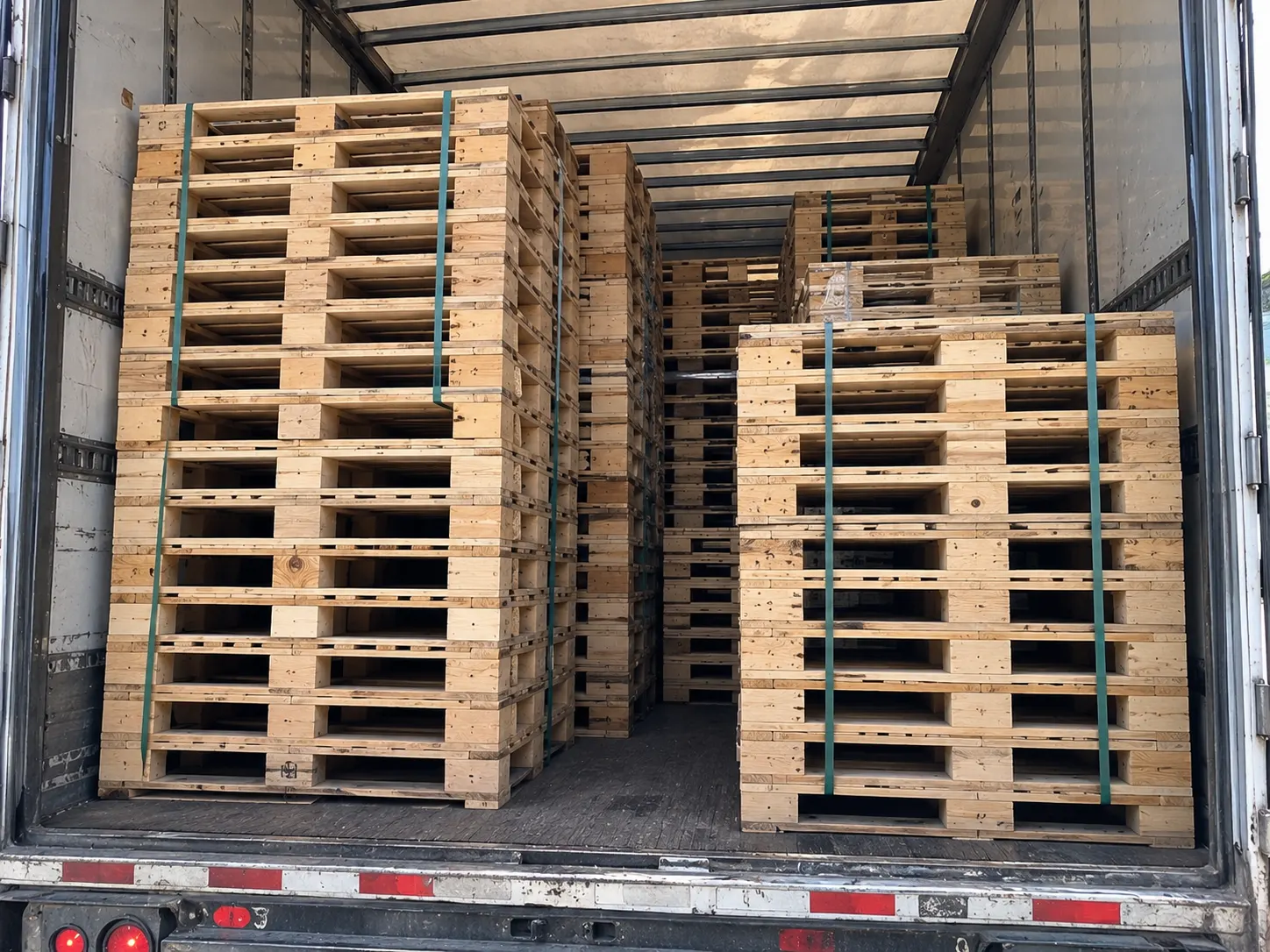
One trailer, two jobs
The truck that brings your pallets can take your surplus away
A delivery returning empty is a trip paid for once and used once. When a supplier backhauls your surplus on the same run, freight cost drops — so ask for a combined quote when you both buy and sell.
What you can source
Decks, crates, bins and everything bolted to them
A catalogue built on reuse first. If a reclaimed unit will carry your load safely, there is rarely a reason to buy new lumber.
Recycled pallets
Grade A, Grade B and #2 reclaimed 48×40 and odd-size stock, re-graded and stamped.
Built to specNew pallets
Fresh-milled stringer and block builds when load rating or hygiene rules out reuse.
ExportHeat-treated / ISPM-15
Kiln-run, IPPC-stamped stock from partner suppliers for freight that leaves the country.
Cut to orderCustom & odd-size
Anything from 24×24 display skids to 96×48 machinery platforms.
Closed loopPlastic & hybrid
Washable polymer decks for pharma, food and automated lines.
ContainmentCrates, boxes & bins
Wood crates, collapsible bulk bins, half-crates and produce boxes.
Add-onsAccessories
Pallet collars, top caps, slip sheets, runners, corner boards and edge protectors.
Second actUpcycled goods
Furniture, wall cladding, planters and reclaimed lumber milled from retired decks.
EverythingThe full catalogue
Every type available through our network, with grades, footprints and load ratings.
Grading, in plain language
You should know exactly what arrives on the truck
Reputable suppliers grade every unit against a written definition. Pricing for each grade is quoted by partner suppliers and depends on size, count and location.
Grade A
Customer-facing and racking
- No broken boards
- Original stringers, no plugs
- Clean, dry, no staining
- Racks and conveys without question
Grade B
Everyday shipping
- Up to 2 companion-board repairs
- Minor weathering permitted
- Full board count
- Floor and truck duty
Grade #2
One-way and internal moves
- Plugged or doubled stringers
- Mixed board widths
- One-way shipping duty
- Not for open racking
Core / scrap
Repair stock and recycling
- Broken, unsortable or wet
- Feeds a repair line
- Becomes runners and mulch
- Bought back by recyclers, not sold
Reference desk
The size chart people actually bookmark
Footprints, load ratings, board counts and tolerances for every common standard — plus the industry quirks that trip up first-time buyers.
Key takeaways
- 48" × 40" GMA is the North American default footprint.
- A standard 48×40 wood stringer pallet weighs roughly 30–48 lb empty, depending on wood and moisture.
- Euro EPAL 1 is 1200 × 800 mm — it will not fit a standard 48-inch US rack bay without overhang.
- Racking capacity is always lower than floor-stacked capacity. Ask for the racked number.
Sector by sector
What your industry actually buys
Each sector has a quirk the others do not. Find yours and you will know what to ask for before you send a request.
| Industry | Primary size | Typical grade | Net flow | Watch out for |
|---|---|---|---|---|
| Grocery & CPG | 48" × 40" | Grade A | Inbound heavy | Retail DC gate rejections |
| Beverage & brewing | 48" × 40" | A or new | Strongly inbound | Heavy, dense unit loads |
| Produce & floral | 48" × 40" | A / B | Balanced | Wide deck spacing for airflow |
| Greenhouse & nursery | 48" × 45" | B | Seasonal spike | Odd sizes vanish every April |
| Pharmaceutical | 48" × 40" | New / plastic | Outbound heavy | No service history permitted |
| Print & paper | 48" × 40" | New / heavy | Inbound heavy | Point loads snap deck boards |
| Chemical & drum | 42" × 42" | A / new | Balanced | Four point loads, not distributed |
| Automotive | 48" × 45" | Custom | Closed loop | Returnable racks and bins |
| Construction supply | 48" × 40" | #2 / core | Inbound heavy | Wet, heavy, mortar dust |
| Cannabis cultivation | 42" × 42" | B / plastic | Strongly inbound | Washdown in dry rooms |
| 3PL & warehousing | 48" × 40" | Mixed | Both directions | Client-specific grade specs |
| Retail back-of-house | 24" × 40" | A | Inbound heavy | Low per site, high per chain |
"Net flow" is the most useful column on this table. If more pallets arrive than leave, you are a seller as well as a buyer — and the two invoices usually net in your favour. Full detail on pallet sizes by industry.
Learned the hard way, by other people
Six mistakes that cost real money
- 01
Quoting dynamic capacity for a racked application
Racked load — spanning two beams with nothing underneath — is well below the dynamic figure most suppliers quote.
Instead: Ask for the racked number explicitly, build in a safety margin, and check the beam rating as well as the pallet.
- 02
Buying Grade A for internal moves
You pay extra for appearance that nobody outside your building ever sees, and at volume that adds up quickly.
Instead: Match grade to who receives the pallet. Most operations should be buying two grades rather than one.
- 03
Accepting a mixed load without a count per grade
You are paying for a mix you cannot verify, and the supplier has no obligation to any particular one.
Instead: Require a count per grade on the delivery note, and ask the supplier to stamp the grade on each unit.
- 04
Paying a hauler to remove pallets you are also buying
The most common pattern in this trade. Two invoices for the same commodity, usually on two different budgets, so nobody ever sees them side by side.
Instead: Put the removal invoice and the purchase invoice on one page, and ask for a combined quote that nets one against the other.
- 05
Treating a notched stringer pallet as four-way
It is four-way for forks and two-way for a pallet jack, whose wheels must run between the bottom boards. Drivers end up reversing thirty feet to approach from the other side.
Instead: If jacks handle your pallets from more than one direction, specify block construction. Notching does not substitute.
- 06
Never measuring loss rate
Most operations guess their pallet loss far lower than it really is. Loss eats into everything you paid for durability.
Instead: Four numbers once a month: received, shipped, purchased, counted at month end. Three months gives you a real baseline.
Send these and a supplier can quote in one reply
Nine answers, one page. It is the difference between a price in one reply and four emails next week.
- Unit load weight, including the pallet itself
- Racking, or floor storage only
- Forks, pallet jack, conveyor or crane
- Who receives it at the far end
- Destination country
- Whether the pallet comes back
- Dock height, or no dock at all
- How many, and how often
- Any surplus pallets going out
Two decisions
The choices that decide most pallet programmes
Almost every specification question we are asked reduces to one of these two. Get them right and the rest is detail.
Stringer construction
Three longitudinal beams · the North American default
- Cheapest per unit and the easiest to repair
- Forks enter the 40-inch ends freely
- Notched outer stringers add fork access from the sides
- A pallet jack still enters only from the ends
- Weakest at the stringer ends, where forks strike
- Widely available reclaimed in every grade
Block construction
Nine solid blocks · genuine four-way entry
- Forks and jacks enter from all four sides
- Stiffer deck — the choice for conveyors and ASRS
- Blocks resist end impact far better than stringer ends
- Costs more to build, but usually lasts more trips
- Standard construction for pooled and European systems
- Reclaimed block stock is scarcer than stringer
Decide it with one question: do pallet jacks handle your pallets from more than one direction? If yes you need block construction, and no amount of notching substitutes for it.
Reclaimed wood
The most common pallet in circulation
- Priced by grade — usually the lowest-cost option
- Reuse avoids building a new pallet at all
- Damage is usually a repair, not a write-off
- Widely stocked in standard sizes
- Can be cut to most footprints
- Cannot be sanitised; not for washdown
Polymer decks
Right in four specific situations
- Much higher upfront cost; reconditioned units cost less
- Higher material footprint per unit than wood
- A cracked deck is the end of the asset
- Washable and verifiably sanitisable
- Holds automation tolerances reliably
- Never needs ISPM-15 treatment or stamping
Three things settle it: wash frequency, loss rate and trip count. If many pallets never come back, polymer rarely pays off against reclaimed wood.
Vocabulary
The words that will come up in a quote
Pallet-trade language is specific rather than obscure. Twelve terms cover most conversations; the glossary has the rest.
- Stringer
- One of three longitudinal beams in a stringer pallet, typically 1.375 × 3.5 × 48 inches.
- Block pallet
- Construction using nine solid blocks, giving genuine four-way entry for forks and jacks alike.
- Lead board
- The outermost top deck board at each end. Takes every fork strike and fails more often than any other part.
- Shiner
- A fastener that has worked through a board face. An automatic reject at every sellable grade.
- Companion board
- A sound board fastened alongside a cracked one instead of replacing it — the cheapest valid repair.
- Core
- A pallet too damaged to ship but sound enough to repair or strip for parts. Recyclers often still take them.
- Racked
- Either out of square, or stored on rack beams. Context decides which, and both matter commercially.
- Racked load
- Capacity while spanning two beams with no support beneath. Always the lowest of the three ratings.
- Chamfer
- A 45-degree bevel on a bottom board edge so a pallet jack rolls on instead of catching.
- HT
- Heat treated to 56 °C wood core for 30 continuous minutes — the ISPM-15 requirement for export freight.
- Backhaul
- Loading a trailer on its return leg. The single biggest lever on pallet freight cost.
- Punky
- Soft, degraded wood. No repair helps; the material itself has failed rather than the assembly.
Serving the Front Range
Where our partner network works
We take requests from Denver and Colorado; availability depends on partner suppliers. Lead time, freight cost and minimum order follow distance from the supplier, so the quote you get spells them out rather than a blanket promise.
| Area | Places | What to expect |
|---|---|---|
| Denver metro | Denver, Aurora, Commerce City, Thornton, Lakewood | Most requests can be matched locally |
| Front Range | Boulder, Longmont, Castle Rock, Greeley, Fort Collins, Colorado Springs | Usually served by partners on the I-25 corridor |
| Rest of Colorado | Pueblo, Limon, the eastern plains, Grand Junction | Depends on partner availability; minimums may apply |
Questions we answer every day
Straight answers before you ask
Can I sell used pallets as well as buy them?
Yes. Partner buyers in our network take surplus stacks of 48×40 GMA, block, Euro and odd-size wood pallets from warehouses, breweries, growers, printers and distributors across the Front Range. What a buyer offers depends on grade, size, mix, count and how clean the stack is, and each partner buyer quotes it separately.
If a stack is mostly broken, a recycler will usually still take it — the wood becomes repair cores, runners, mulch or boiler fibre instead of a tipping fee on your invoice.
How fast can I get recycled 48x40 pallets in Denver?
It depends on the supplier and on what is in stock. Grade A and Grade B 48×40s are the most commonly stocked pallets in the Denver metro, so standard orders are usually the easiest to fill. Heat-treated and custom builds take longer because they go through a kiln or a saw line. The partner supplier who quotes your request confirms the lead time.
Are used pallets actually better for the environment than new ones?
Generally, yes. Reusing or repairing a sound pallet avoids milling, assembling and shipping a new one, and every extra trip a deck makes spreads that original footprint further. Wood that can no longer be repaired is usually ground into mulch or fuel rather than landfilled. More on how the reuse loop works.
What does ISPM-15 heat treatment mean and do I need it?
ISPM-15 is the international phytosanitary standard for wood packaging. If your freight crosses a border, the pallet must be heat-treated to 56 °C core for 30 minutes and carry a registered IPPC stamp. Domestic freight does not need it. Partner suppliers in our network supply heat-treated, stamped stock — see the compliance guide.
Does it cost anything to have pallets picked up?
It depends on count, condition and location. Larger loads of usable pallets are often collected free, and partner buyers may pay for the usable units. Small or mostly broken loads usually carry a haul fee, sometimes netted against what the usable units are worth. The partner supplier's quote spells out both before anything moves.
Can you build a pallet to a size that isn't standard?
Yes, through partner suppliers who build to order from reclaimed or new lumber depending on load rating. Send us the footprint, the static and dynamic load, and whether it racks — we pass it to suppliers in our network who can quote it. Start on the custom pallet page.
Field guides
Guides to buying, selling and recycling pallets
No gated whitepapers. Plain-language guides to grades, sizes, costs and compliance.
Pallet grades explained
What A, B, #1 and #2 actually mean — and how to spot a mis-graded stack on the dock.
BuyingPallet procurement guide
What to specify, what drives the quote, and how to compare suppliers on more than unit price.
How-toHow to sell used pallets
Sorting, staging and counting so your stack is worth the most when the truck arrives.
InsideInside pallet recycling
Eleven steps from inbound scale ticket to outbound mulch screen.
ComparisonWood vs plastic
Lifecycle carbon, hygiene, cost per trip and when plastic genuinely wins.
ReferencePallet glossary
Stringer, chamfer, shiner, companion board — the language of the pallet trade.
Send one request. We match it to suppliers who can quote it.
Tell us the quantity, the grade and the location. We pass it to partner suppliers in our network, and one follows up with pricing and a window.